


Active File Cleaner
3.251.00 Reviews
App Specs
- Version
- 4.0
- Updated On
- License
- Free
- Downloads
- 100,000+
- Developer
- Glorich Limited
- Categories
- Tools
- Platform
- Android
Screenshots
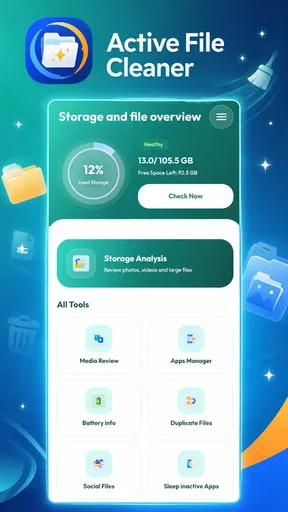
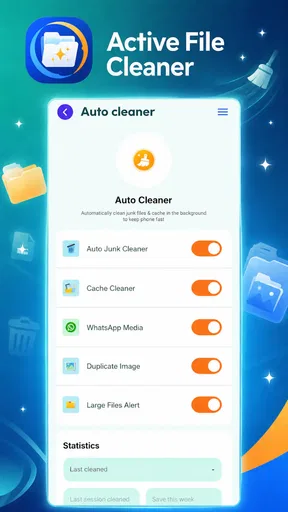
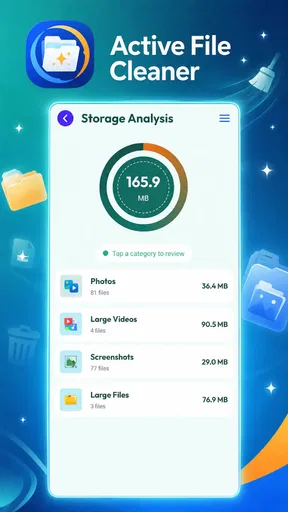
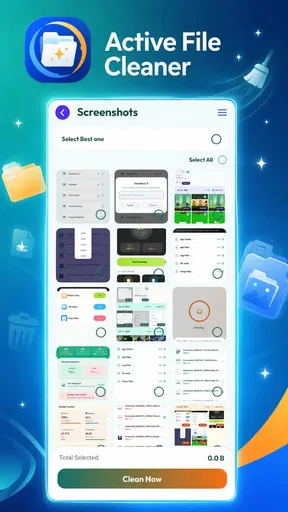
 Analysis by AppCompare
When my phone starts warning me about storage, I usually do not want a complicated maintenance suite. I want a clear way to see what is taking up space, remove files I no longer need, and avoid deleting something important by mistake. Active File Cleaner is built for that everyday task. It is a free tools app from Glorich Limited, and its main appeal is its straightforward purpose: helping users deal with cluttered files without turning storage management into a technical project.
After spending time with it, I see it as a practical option for people who want a dedicated cleanup utility rather than a broad phone-optimization package. It is especially suitable for someone who regularly downloads documents, saves images from messaging apps, or lets temporary files accumulate. At the same time, I would not treat it as a magic solution for every storage problem. Its value depends on how clearly it presents files for review and how carefully the user checks what is about to be removed.
How Active File Cleaner feels in everyday use
The current version is 4.0, and that gives the app the feel of a maintained utility rather than an abandoned experiment. I found the most useful way to approach it was not to open it only when storage was already critically low, but to use it as a periodic checkup. That change in habit matters: cleaning a manageable amount of clutter is less stressful than trying to sort through months of accumulated downloads in one rushed session.
The app’s role is narrower than that of a complete device manager. It focuses on files, so the natural starting point is storage housekeeping: looking for material that has become irrelevant, identifying duplicate-looking content where applicable, and separating useful personal files from disposable clutter. I would still use the phone’s own storage settings for a broad overview of applications and system usage, because those settings remain the authority for understanding what occupies the entire device.
That division of labor is one of the first practical lessons. Active File Cleaner can be useful for the file layer, while the operating system is better for application storage, system data, and account-level controls. Expecting one small utility to solve both jobs can lead to disappointment. Used for the job it is designed around, the app is easier to understand and less likely to encourage unnecessary deletion.
The app is available at no cost and carries an Everyone age rating, which makes it approachable for a wide range of users. It supports Android 8.0 and later, so it can serve people using older compatible phones as well as newer devices. That broad compatibility is helpful for households where not everyone has the latest handset, although the practical experience can still vary depending on the phone manufacturer and its file-access behavior.
A realistic cleanup routine
Imagine a common Saturday morning situation: I have downloaded several PDF menus, opened image attachments from a group chat, and saved a few short videos that I meant to share but never did. The phone is not unusable, but free space is shrinking and finding the unwanted files manually would take time. I would open Active File Cleaner, review the categories or results it presents, and begin with items whose purpose is obvious and whose copies already exist elsewhere.
Worth Reading Before You Choose

EA SPORTS FC Mobile 26 Is a Bigger Football Game, but It Takes Time

Flipboard Shows What News Apps Must Do Beyond the Feed

Switching to Android Auto Means Rethinking Your Driving Routine

Google Calendar Makes a Crowded Week Easier to Manage

Ludo King Makes the Most of the Minutes Between Plans

Baby Panda World Brings Quick Play to Modern Phones, but Its Game Library Feels Busy
The important part is the review step. I would not select everything simply because the app identifies it as removable. A screenshot may look disposable but contain a receipt. A downloaded document may seem old but still be needed for travel or work. My preferred workflow is to clean in small batches: first obvious temporary material, then repeated media, and finally older downloads after opening anything that looks ambiguous.
This approach also reveals a less obvious benefit. A cleaner can act as a visual reminder of how I use my phone. If the same type of file keeps returning, the long-term fix may not be deletion. I might need to change where a messaging application saves media, stop downloading files automatically, or move personal videos to another location. In that sense, the app is most useful when it helps me change habits rather than merely emptying a folder.
Where it compares well with built-in tools
Android already includes storage management, and many phones add their own file browser or cleaning suggestions. Those built-in options have an important advantage: they are closely integrated with the operating system and usually provide the safest route for system-level decisions. If I only need to uninstall a large application or inspect general storage categories, I would start there.
Active File Cleaner makes more sense when I want a focused file-cleaning session. A dedicated interface can reduce the distraction of unrelated settings and make a quick review feel more intentional. It may also be easier for a less technical user to understand than a storage page filled with application caches, system categories, and manufacturer-specific terminology. The trade-off is that a separate cleaner may not have the same depth of access or context as the phone’s own tools.
Compared with a full file manager, the app is also more specialized. A file manager is better when I need to rename folders, move work documents, browse external storage, or organize files manually. Active File Cleaner is the better fit when the immediate question is, “What can I safely clear?” rather than, “How should I restructure all my files?” Choosing between them depends on whether the problem is clutter or organization.
What the current release tells me
The move to version 4.0 is the clearest confirmed sign of the app’s current product stage. I read that as evidence of an established iteration path, not as proof that every desired feature is present. A version number alone cannot tell me how much the interface has changed internally, so I would avoid assuming that it includes a particular scanning method, automation system, or privacy control unless the app itself clearly shows it.
That distinction is important for existing users. Someone updating from an earlier release should approach the first cleanup session carefully, even if the app looks familiar. A refreshed presentation can change how results are grouped or how selection works. My advice is to inspect the review screen after updating, confirm that personal folders are recognizable, and avoid running a broad cleanup on autopilot.
For a new user, version 4.0 is reassuring mainly because it provides a clear starting point. I would install it, look at the initial categories, and learn what the app considers removable before relying on it regularly. The best sign of a good update is not a flashy change; it is whether the app makes decisions easier to verify. That is the standard I would apply while using this release.
Who will get the most from it
Active File Cleaner is a good match for people who accumulate files through ordinary phone use. Students may find it useful after downloading lecture material, screenshots, and shared media. Families can use it to review a device that has become crowded with forwarded images. Someone with an older phone may appreciate having a focused way to reclaim space without learning a complex file system.
It is also helpful for users who do not want to hand their entire storage routine over to aggressive automation. A manual review gives me a chance to make a distinction between disposable clutter and personal content. That is particularly valuable on a phone where photos, scans, voice recordings, and downloaded documents sit close together.
I would be more cautious about recommending it to a person who expects one tap to solve a nearly full device. If most of the storage is occupied by large games, offline video, camera recordings, or applications, a file cleaner may only address a small part of the problem. In that situation, Android’s storage screen, an uninstall review, or a deliberate media backup will probably produce better results.
Small workflow improvements that make a difference
My first tip is to clean by confidence level, not by file age alone. Start with items I can identify immediately, such as an accidental download or a duplicate attachment. Age is a weak signal because an old tax document or travel confirmation can remain important. This simple rule reduces the chance of turning a convenient cleanup into a recovery task.
My second tip is to check the source of repeated clutter before deleting it. If the same images return every week, the real issue may be automatic media saving in another app. Active File Cleaner can help expose the pattern, but it cannot replace changing the setting that creates it. Deleting the same material repeatedly is less efficient than preventing unnecessary copies from appearing.
My third tip is to leave a little time between review and permanent removal when the files are personally important. I prefer to move valuable items elsewhere first, then clean the remaining material. This is especially sensible for recordings, scans, and documents that do not have obvious filenames. A cleaner should support a careful decision, not pressure me into making one quickly.
A fourth useful habit is to compare the result with the phone’s own storage view after cleaning. If the available space barely changes, that tells me the main problem lies elsewhere, perhaps inside applications or large media files. If the result is meaningful, I know the app is addressing the right kind of clutter for my device. This quick comparison prevents me from repeatedly scanning the wrong category.
Limitations I would keep in mind
The biggest limitation is inherent to the category: file cleanup requires judgment. Even a well-presented result can contain items that matter to me personally. The app can help organize the decision, but I remain responsible for checking names, locations, previews, and duplicates before confirming removal. Users who want completely risk-free automation may find that frustrating, but it is preferable to silent deletion.
Another limitation is the boundary between files and applications. Clearing visible files will not necessarily reduce the space used by installed apps, offline maps, game resources, or protected system data. If my storage problem comes from those areas, I would switch to the relevant Android settings instead of repeatedly asking this app to do a job outside its natural scope.
There is also a trade-off between simplicity and detail. A focused cleaner can be easier to use than a full file manager, but advanced users may want deeper folder controls, custom rules, or more granular sorting. If I need to manage a large archive, preserve a complex folder structure, or move files between locations, a dedicated file manager is likely the stronger choice.
The average rating of 3.4 from around 300 ratings suggests a mixed but meaningful reception. I would interpret that as a reason to test the workflow on my own phone rather than assuming it will feel perfect for everyone. With utilities, device differences matter: storage layouts, manufacturer interfaces, and file permissions can affect how useful a cleanup session feels.
What existing users should do after updating
For someone already using the app, I would begin with a conservative pass after moving to version 4.0. I would inspect whether the categories are arranged differently, check that familiar personal folders still appear as expected, and run a small cleanup rather than selecting a broad set immediately. This is not because an update is automatically risky; it is simply a sensible way to understand any changed workflow.
I would also keep track of what kind of clutter the app actually finds on my phone. If it mostly surfaces downloads, it may be worth creating a weekly download review. If it highlights repeated images, I would adjust media-saving behavior elsewhere. If it finds little, I would stop treating it as a general performance booster and use it only when a specific file problem appears.
That measured approach helps separate genuine improvement from expectation. A newer release can make navigation clearer or cleanup more convenient, but it does not change the physical limits of the phone. No version can create lasting space if I continue saving large media without a storage plan. The app is a tool in a routine, not a substitute for one.
What I would watch going forward
When I judge future updates, I will pay attention to how clearly Active File Cleaner explains each recommendation before removal. Better explanations, readable file details, and an obvious review stage would matter more to me than aggressive scanning. For this type of app, trust is built through transparency: I should understand why an item is being suggested and what action will follow.
I would also watch how well the app handles the boundary between harmless clutter and personal files. Useful improvements would be anything that makes it easier to protect important folders, distinguish repeated downloads from true duplicates, and recover from an accidental choice. I am not assuming those capabilities are present; they are simply the areas that determine whether a cleaner becomes a dependable habit.
Privacy and permission clarity would remain important as well. A file-cleaning tool necessarily deals with personal storage, so I want its on-screen explanations to be easy to follow. Before using any cleanup feature, I would read the permission prompts and make sure the access requested matches the task I am trying to complete. That is good practice with any utility that handles local files.
My final take
Active File Cleaner is best understood as a focused housekeeping tool, not a complete phone optimizer. I like it for the practical problem it addresses: finding file clutter when manual browsing has become tedious. Its free price, broad Android compatibility, and simple purpose make it easy to try, while the 100K-plus install level shows that it has reached a real audience.
I would recommend it to someone who wants a guided file review and is willing to check results before deleting them. I would not recommend relying on it alone when the phone is full because of applications, large personal videos, or system storage. In those cases, the built-in storage controls or a full file manager are better companions.
For me, the strongest way to use Active File Cleaner is as part of a small, repeatable routine: review obvious clutter, protect anything personal, identify the source of repeated files, and confirm the result through the phone’s storage settings. The app does not need to do everything to be useful. It simply needs to make this one unpleasant job clearer and safer, and in that role it is worth considering.
Pros
- Quickly removes temporary and junk files to free up storage.
- Simple interface makes routine cleaning easy for most users.
- Helps identify large files that may be taking up unnecessary space.
- Useful for maintaining cleaner storage on older Android devices.
- Cleaning options can reduce clutter without requiring advanced technical skills.
Cons
- Some features may require in-app purchases or premium access.
- Aggressive cleaning can remove files you intended to keep if unchecked.
- Results may vary depending on device model and Android version.
- Frequent notifications or ads may interrupt the cleaning experience.
- It cannot replace a complete backup or dedicated security solution.
FAQs for Active File Cleaner
What is Active File Cleaner, and what does it do?
Active File Cleaner is a utility designed to help identify and remove unnecessary files from a device. Depending on the version and platform, it may scan for temporary files, cache data, duplicate items, leftover installation files, and other storage clutter. Its main purpose is to free space and make file management easier, although it should be used carefully before deleting anything important.
Is Active File Cleaner safe to use on Android or iOS?
Active File Cleaner can be useful when downloaded from a legitimate store or official source, but users should still review its permissions, privacy policy, developer information, and recent reviews before installing it. Cleaning applications may request access to storage or files. Avoid granting permissions that seem unrelated to its purpose, and always check the selected files before confirming deletion.
Can Active File Cleaner delete personal photos, videos, or important documents?
The application should normally focus on files identified as unnecessary, but no cleaning tool can replace careful user review. Depending on its scan settings, large files, duplicates, downloads, or old documents may appear in the results. Before using the cleanup option, inspect the list carefully, deselect anything you want to keep, and create a backup of valuable content whenever possible.
Does Active File Cleaner really improve device performance?
Removing temporary data and freeing storage can make a device feel less cluttered and may help when storage is nearly full. However, Active File Cleaner cannot solve every performance problem. It will not replace system updates, battery maintenance, or removing genuinely demanding applications. Results depend on how much unnecessary data is found and the condition of the device.
Is Active File Cleaner free, and are there advertisements or in-app purchases?
The availability of free features, advertisements, subscriptions, or one-time purchases can vary by platform and version. Before downloading, check the application’s store listing for the current pricing details and review the purchase screen carefully. Some features may be limited in the free edition, while advanced scanning, automatic cleaning, or an ad-free experience may require payment.


